Few sub-brands in the automotive world carry as much weight with enthusiasts as AMG. The three letters have become shorthand for hand-built V8s, race-ready chassis engineering and a very particular kind of German precision. But in 1967, AMG was just two men in a converted mill in Burgstall an der Murr.
Aufrecht, Melcher and Großaspach
Hans Werner Aufrecht and Erhard Melcher — both former Mercedes-Benz engineers — founded Aufrecht Melcher Großaspach in 1967. The "G" came from Aufrecht's birthplace. From the start the company's mission was clear: take Mercedes production engines and make them race-grade.
The Red Pig and legitimacy at Spa
In 1971, AMG entered a modified 300 SEL 6.8 in the Spa 24 Hours. The car — nicknamed "the Red Pig" for its size and color — finished second overall and first in class, humiliating the lightweight sports cars it had no business beating. The result put AMG on the map and gave Mercedes dealers an unspoken reason to send performance-minded customers their way.
The hand-built V8 era
Through the 1980s AMG built a reputation for discreet, extraordinarily fast Mercedes sedans. The famous "Hammer" of 1986 — a W124 E-class with a 32-valve 5.6-liter V8 — was for a brief moment the fastest four-door car in the world. Each engine was built by a single technician, who signed the valve cover.
Full integration with Mercedes-Benz
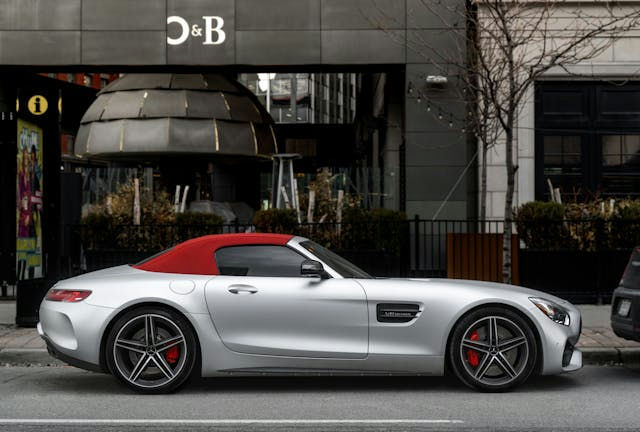
DaimlerChrysler acquired a majority stake in AMG in 1999 and completed the full acquisition in 2005. The brand transitioned from aftermarket tuner to in-house performance division. Models like the SLS AMG — the first car designed entirely by AMG — and the AMG GT established the division as a credible rival to Porsche and Ferrari on their own ground.
Electrification and the future
AMG's current product line stretches from four-cylinder hot hatches like the A 45 S to the plug-in hybrid GT 63 S E Performance, with a battery-electric AMG GT 4-Door and the AMG-badged EQE and EQS sedans anchoring the shift to electrification. The "one man, one engine" principle still applies to internal combustion builds; whether it will survive the electric era is one of the more interesting open questions in the industry.
What hasn't changed is AMG's role: to be the sharpest, loudest, most engaging interpretation of whatever Mercedes-Benz builds. The badge still means something — and after more than 55 years, that's rare.